Full-Stack Web Application · Case Study

Enterprise GST Billing & Accounting Platform

An offline-first, single-file web platform that runs a small business's entire GST-compliant workflow — invoicing, receivables, purchases & input-tax-credit, CRM and statutory GST return filing — with real-time multi-device sync and no backend server of its own.
13integrated modules
7GST document types
0backend servers / build step
100%offline-capable
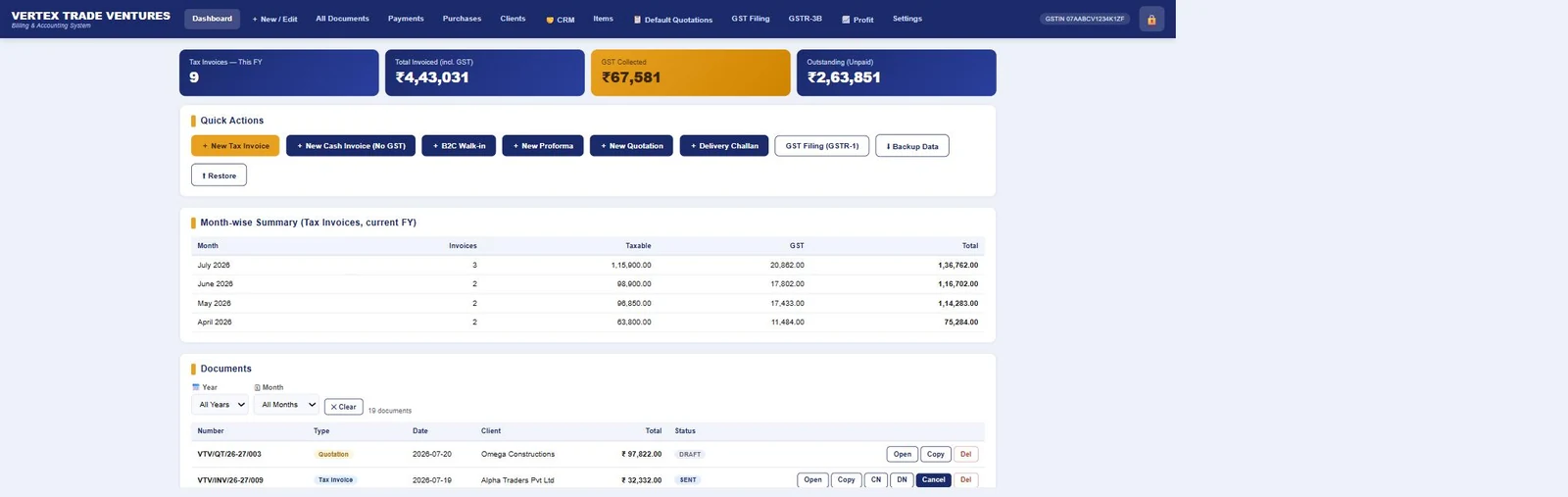
Dashboard of the Enterprise GST Billing & Accounting Platform showing financial-year KPIs, month-wise summary and the document register
Industry
Retail / Distribution + Project Services (India, GST regime)
Project Type
Client-side SPA · Vertical internal tool
My Role
Sole Full-Stack Engineer — end-to-end
Core Stack
Vanilla JS · IndexedDB · Firebase (Auth + Firestore)
Client
Confidential SMB (anonymized)
Project Overview

A complete accounting back-office, shipped as one HTML file

The platform replaces a patchwork of spreadsheets and generic invoice tools with a single, purpose-built application that understands Indian GST law end-to-end. It is written as a self-contained HTML file with vanilla JavaScript — no framework, no build pipeline — using IndexedDB as an instant offline working store and Firebase Firestore to mirror every change across devices in real time.

Because the data model, tax engine and compliance guardrails are built into the client, a non-technical owner can raise a legally-correct tax invoice, record a payment, reconcile input-tax credit and export a portal-ready GST return — from any device, even offline — without ever touching a spreadsheet formula.

Business value

  • Compliance by construction — GSTIN checksum validation, mandatory HSN, paise-true tax splits and issued-document locks stop errors before they reach a government return.
  • Cash-flow visibility — receivables aging and per-item/per-job profit turn raw documents into decisions.
  • Zero infrastructure cost — deploys as a static file; the only backend is managed auth + database.

Key capabilities

  • 7 GST document types with a live CGST/SGST vs IGST tax engine and financial-year auto-numbering.
  • GSTR-1 JSON/CSV export, GSTR-3B net-payable with legal ITC set-off, and GSTR-2B reconciliation.
  • GST-certificate OCR auto-fill, CRM pipeline, purchases/ITC register, and an owner's P&L.
The Challenge

Off-the-shelf tools didn't fit the business — or the law

Business problem

  • Generic invoicing apps couldn't model India's GST rules — intra- vs inter-state tax, HSN/SAC, reverse charge, credit/debit notes, or return formats.
  • Spreadsheets allowed duplicate invoice numbers, silent tax-rounding errors, and no audit trail — each a real compliance risk.
  • The business mixes stocked goods with project work, so profit had to be tracked by item cost and by job — impossible in a simple biller.
  • Work happened across multiple devices, often with poor connectivity, so a cloud-only tool was unusable on-site.
  • Filing GSTR-1 and GSTR-3B by hand from disconnected records was slow and error-prone.

The solution

  • A purpose-built, offline-first application with the GST domain model — tax engine, numbering, and compliance guardrails — baked into the client.
  • IndexedDB for instant local reads; Firestore for real-time sync with a transactional numbering scheme so two devices can never mint the same invoice number.
  • Cost captured per invoice line and per job, feeding a real Profit & Loss view with item- and job-level margins.
  • One-click GSTR-1 / GSTR-3B exports with a pre-flight quality gate that blocks anything the portal would reject.
  • Shipped as a single hardened HTML file — SRI-pinned dependencies, escaped output, password-gated destructive actions.
Product Walkthrough

Thirteen modules, one coherent workflow

Every screenshot below is captured from the running application using anonymized placeholder data. Each module was designed, built and hardened by me.

How It Was Built

Engineering process

Technologies Used

A deliberately small, dependency-light stack

No framework and no build step — the entire application is one HTML file. Every third-party library is loaded from a version-pinned CDN with Subresource Integrity so a compromised CDN cannot inject code.

Hard Problems

Challenges & how I solved them

Outcome

Results & impact

Framed for a single-owner internal product — the wins are about correctness, resilience and decision-support rather than vanity metrics.

Invoice line items with HSN-wise tax summary, bank details and invoice summary
Line items → HSN tax summary → invoice totals, with COGS captured per line.
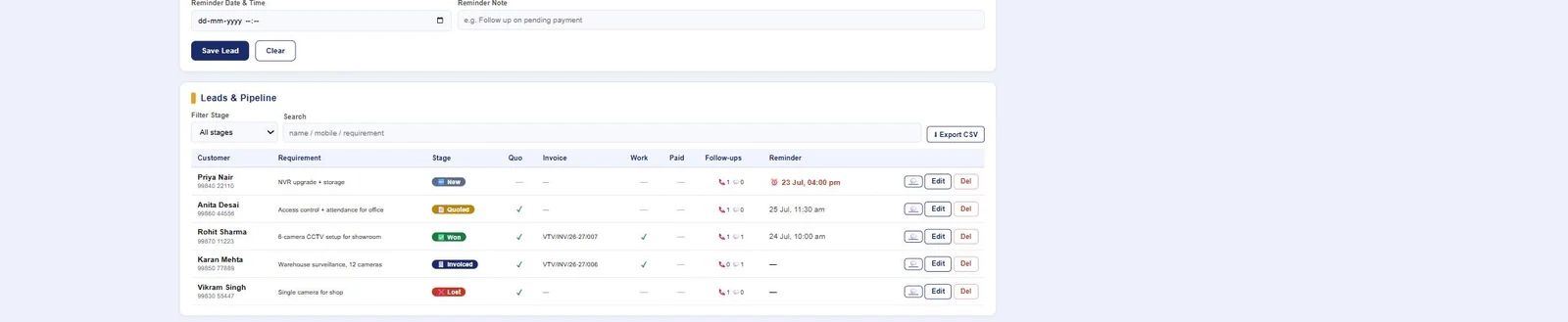
CRM leads pipeline across New, Quoted, Won, Invoiced and Lost stages
CRM pipeline tracking every enquiry from lead to payment.
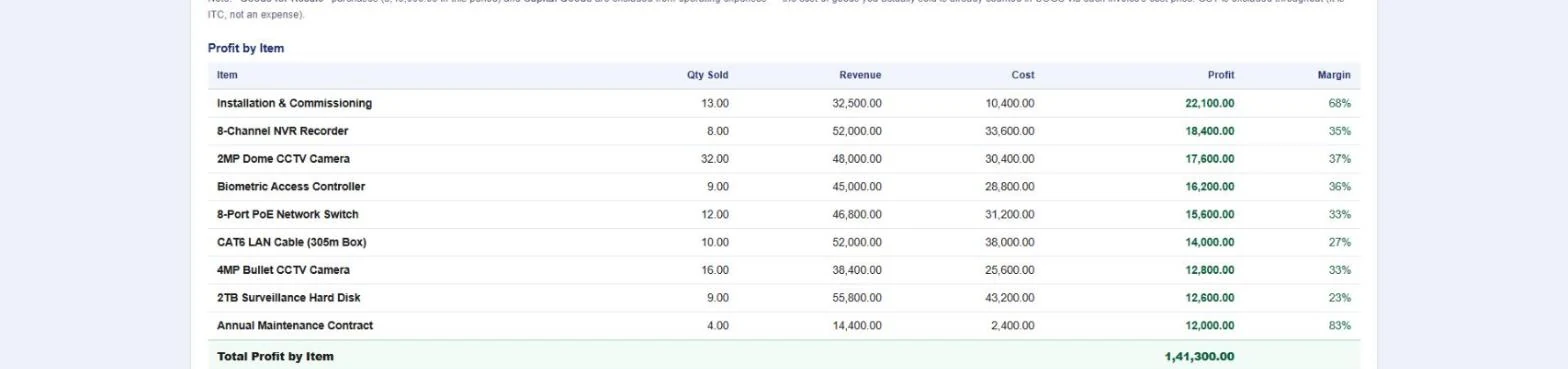
Profit-by-item table showing per-product revenue, cost and margin
Profit-by-item margins derived from per-line cost prices.
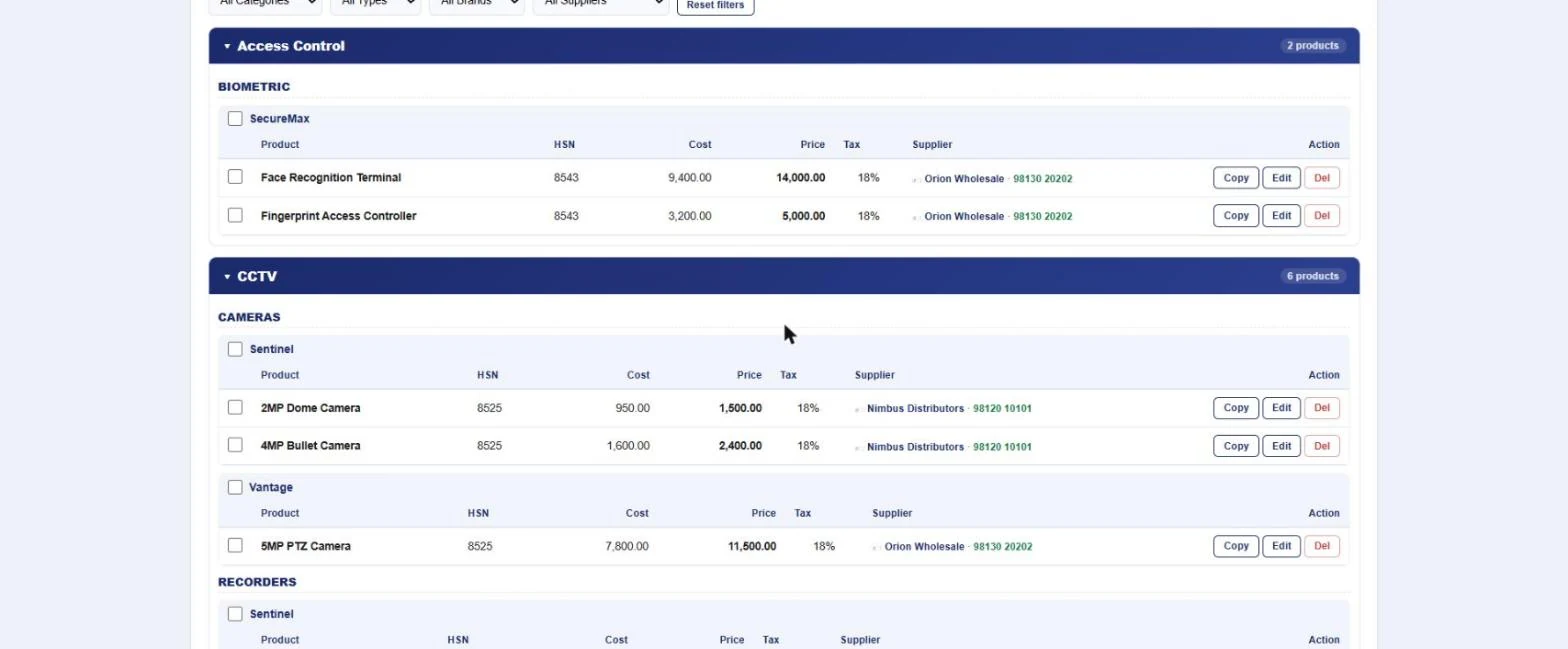
Price-list catalog grouped by category, sub-category and brand
Reusable price-list catalog, grouped Category → Sub-category → Brand.
Conclusion

What this project demonstrates

Delivering this platform solo meant owning the full arc: interpreting a dense regulatory domain, choosing an architecture that fit real-world constraints (intermittent connectivity, non-technical users, zero infra budget), and engineering it to a standard where correctness and security are structural rather than aspirational. It shows I can model a hard domain, make pragmatic architectural trade-offs, hold a security mindset, and ship a complete, dependable product end-to-end.

Domain modeling under regulation Offline-first architecture Real-time data sync & conflict resolution Financial correctness & rounding Application security Vanilla JS at scale UX for non-technical users End-to-end delivery
Anonymization notice. This case study describes a real project built for a confidential client. The client name, brand, logo, contact details, address, GSTINs, people and all financial figures shown in screenshots have been replaced with fictional placeholders (e.g. “Vertex Trade Ventures”, placeholder clients Alpha/Beta/Gamma, and demo amounts). Nothing shown identifies the real business or its customers.